

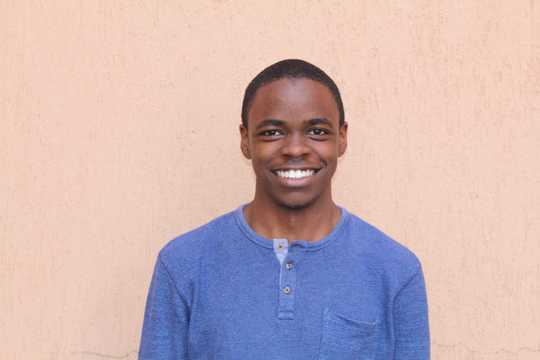
When you think of a data scientist, what comes to your mind? Perhaps the picture painted in your mind is that of someone sitting in front of a computer screen crunching numbers and making sense of zeros and ones all day. Well, that is only one part of the job, but according to Andrew Anampiu, a Data Scientist, Technical Recruiter, and Moringa School alumnus. I had an insightful conversation with Andrew about the nitty-gritty of data science, what it takes to get into it, and how to gain an edge in the field.
Let’s get started with the basics. Who is a data scientist?
Data science is a fairly new thing, but not too new (laughs). It’s kind of when you think of something very experimental in tech, such as AI. I think that’s the biggest buzzword that we hear back and forth when you think about tech right now. Simply put, it’s being able to look at data, clean it, interpret it and make predictions. It takes several variations, whether it's AI, machine learning, business analysis, financial analysis or basic analysis in insurance. All you have to do is look at data and numbers and see what the data is telling you.
What drove you to become a Data Scientist?
I think it’s a mixture of opportunity and interest. I haven’t trained in data science, but how I got into it was mostly through an opportunity that presented itself. I’ve trained in Software Engineering and primarily web development and a little bit of hardware engineering. Early last year when the opportunity came up for me to lead a team of data scientists in some classes, and internal projects, I picked it up as a way to upscale and learn something new. So it’s not necessarily that I spent my whole life practicing and waiting for this moment (laughs). It just happened; I took it up and have been enjoying it ever since.
You mentioned AI, Data Science, and Machine Learning, which are terms that we are increasingly hearing nowadays. What’s the difference?
They all fall under one discipline of data science. So AI can be seen as a branch of data science, the same goes for machine learning.
Think of AI being artificial intelligence, which is in the name itself, building models and structures for computers to learn things and make decisions based on the kind of data that they have. We talked about data science being a discipline where you get data, and you see how it can help you, then translate that to other people who don’t understand what the data means. Machine learning could be seen as a sub-branch of AI where if we need this computer to make decisions, then we need the computer to have the capacity to learn, acquire new knowledge, assess situations, and make decisions.
You wear multiple hats, a Data Scientist and Technical recruiter. What does your average day look like?
First off, I wouldn’t advise people to wear multiple hats (laughs). A lot of what I do has to do with circumstance and being able to juggle. I try as much as possible to have time to myself each day to plan and think about things in a space where it’s quiet and there are not too many meetings going on.
My typical day starts at around 8 am, where I sit with my team of 12 instructors that I manage. I try to sit in on the classes as much as possible, give any feedback around professional skills, and jump in wherever I can. After that, maybe I’ll do a little bit of admin work, write some emails, send out some Slack messages, and then dive deeply into a new technology or existing project that I’m working on. The majority of my day is spent talking to other people and being the coding editor.
I also manage a couple of projects, so I’ll dedicate a huge chunk of my day to getting feedback and status reports on them. I section out an hour or two a day to go through a course, a project, or a youtube video. It doesn’t have to be anything heavy, just to make sure my skills are up to par at any given point. Obviously, while being a normal human being who eats and goes out into the sun. (laughs).
Click here to join Moringa School and learn Data Science or Software Development.
Speaking of hiring season, from a recruiter’s perspective what should job seekers expect in a data science job interview?
The data science job interview isn’t too far off from the normal interview everyone goes through. We try as much as possible to make it competency-based by looking at the projects you’ve worked on or your experience.
There will always be a portion of the interview that’s sectioned out for you to be presented with a problem and offer a technical solution where you walk people through a case scenario. So you should expect to have a phone screen, somewhere to look at your CV, and somewhere to look at your personal website. You should expect a coding interview; you definitely need to come with your laptop and be ready to write some code and run some analysis. And then maybe a culture fit interview to determine if you can work professionally with other people in a professional setting.
Is it necessary to have a background or any extra training in any computer-based courses before joining Moringa School?
I would say this if someone is thinking of coming to Moringa or they are thinking of jump-starting their career as a data scientist, and they are currently in a computer science program if it benefits you, finish it by all means. But that doesn’t necessarily mean you need one to become a data scientist. In some very odd cases, it does help.
I think there are a lot of ways that you can get into data science, one of them being a boot camp like Moringa School, the other being a four-year degree program and a specialization.
What career growth opportunities are available for a Data Scientist?
Oh, they’re very many. Business analysis is one I know, where you walk into any business whatsoever and you’re able to use the data they have to help them make better, profitable decisions towards their desired goals. You can go into different parts of data science such as AI and become an AI engineer, a machine-learning specialist, or a natural language processing engineer. There are very many different paths you can take.
Alternatively, look around and think of some of the problems you want to solve. If you find someone with a similar problem, that means there are more people with the same issue. Consider using the tools that you learned as a data scientist such as analysis methods and programming to create an elegant solution as effectively as possible.
There’s a lot more perspective in that than thinking about job titles and the things that you need to be doing.
Which are the most in-demand skills in data science that one should build to have a competitive advantage?
For you to stand out and look as colorful as possible to employers, you definitely want a little bit of coding background. Aside from being good at data science, data analysis, cleaning, and the likes, you should be able to make your analyses and transform that into a website or present it in a way that people can understand that information. Being very well-rounded in technology itself is a very valuable asset to have. Having a background in statistics and discrete math is an added advantage because data science has a lot of mathematical concepts that we borrow from.
I think the other skills are mostly professional/soft skills; the ability to work well with other people, and very good problem-solving skills to break down a problem and find a solution. Your ability to communicate what you’re working on and the impact of it is far more valuable than being able to write code. This increases your chance of being hired than someone who is very good at coding but cannot articulate their thoughts.
You went through Moringa School’s data science training program. What was your experience and why is it the go-to place for someone looking to pursue this career?
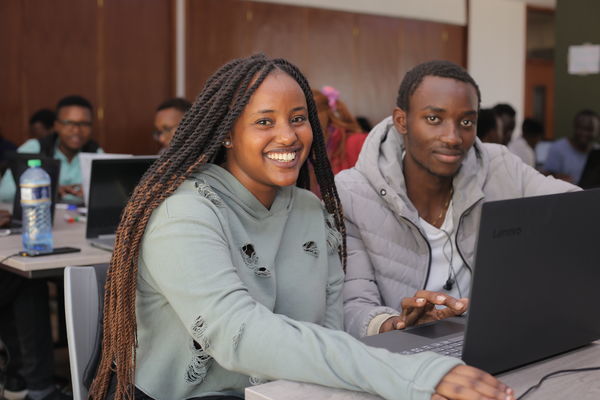
I actually went through the software engineering program, not the data science program (laughs). My experience was pretty good. I think one thing that Moringa taught me was how to manage yourself. At Moringa School, the relationship between the instructors and the students is more of what a manager would have with an employee or a teammate.
A lot of the learning is student-driven. Students need to be very driven to be at Moringa school; constantly seeking knowledge and leveraging the tools around them, whether it is instructors or other students.
I would recommend Moringa school for a lot of reasons. One, it gives you a very hands-on project-based approach. You learn something on Monday, Tuesday, and Wednesday, then on Friday, you have a project that applies what you’ve learned throughout the week. At Moringa school, soft skills are very important to us. We want the graduates to be well-rounded, not just very good programmers or engineers, but people who can exist in any professional setting. You learn how to work with other people, resolve conflicts, present, and write emails. Those things are actually pretty important in the tech ecosystem, and it’s something we stress heavily at Moringa school. The curriculum is definitely something that has made Moringa school stand out. We try as much as possible to make sure it is up to date so students have relevant content when they graduate.
Do you have separate courses teaching the professional skills that you’ve mentioned?
No, actually the soft skills and the professional skills the students need are already integrated into the whole course. So every week, on top of them doing something techy, they’re also learning a few soft skills, working on projects, and learning how to present those projects and their business cases.
And how did you manage to transition from being a student at Moringa school to working there?
I had a very interesting interview process with my previous boss. During my final period of being at Moringa school, problem-solving skills were something that I really displayed as a student; being able to think about ways Moringa school can improve. I think my previous boss noticed that and she gave me an offer at the end of the course to work for them. I think that’s why I put a lot of emphasis on problem-solving skills. It can take you very far as opposed to other skills that people think you need in this type of environment.
Could you give us a high-level view of the Data Science course?
Definitely. The course is broken down into 2 parts: Prep and Core. Prep mostly entails the fundamentals of programming with Python, database languages such as SQL, and an understanding of the relevance of data science. The core involves specializing and diving deeper into the concepts with supervised and unsupervised learning, and then we finish off with programming. At the very end of the course, the students have about three weeks, which we call the project period, to work on real-world programs or solutions for some of our hiring partners or a customer to get a feel of the job environment. They learn about career readiness and how to make sure their LinkedIn, CVs, and cover letters are on point. They also have mock interviews to learn how to stand out to potential employers. That’s a very short overview of what the course looks like.
Would you like to kickstart a career in data science or software development? Apply to join Moringa School and learn from experts. You’ll get placed at one of their employer partners for a hands-on experience upon completion of the course.